Native Advertising: Content Marketing goes Mainstream

Just when you thought social media was going to rule the digital world, it is now clear that content is not only king – it is going mainstream with a new twist.

With more people sharing online content, and especially as more regular Joes and Janes are able to now call themselves publishers, content is now moving to center stage in new ways.

As new media challenged traditional media, banner and video ads were employed by traditional media outlets to monetize their content.

The realization has now dawned that their system is completely broken – people are not clicking on banner ads.

And why should they, you can get all of the free content you want by taking advantage of Google news. Consumers are not only ignoring banner ads, they despise their interruptive qualities.

Get ready for a new (sort of) kind of advertising that is designed to draw you in and hold your attention – it’s called native advertising.

Content Marketing vs Native Advertising

Content marketing is designed to build a relationship with your audience – by giving them valuable content that is designed especially for them. Content informs, it solves problems, and ideally also entertains whenever possible too.

Content marketing builds an audience to earn the opportunity to occasionally make offers to buy your products and services. Obviously, both the content and the offers are designed for a specific audience.

Native advertising is paid content marketing that most likely (but not always) includes a call-to-action for selling products and services. Promoted posts on Twitter are one form of native advertising – another are old-fashioned “advertorials” in newspapers and magazines (like the one in the image above).

The Truth About Native Advertising

You have already experienced native advertising. The only thing new is the name – and the fact that is sure to take marketing with content to a higher level, maybe even an art that fully uses all of the capabilities of digital media.

Native advertising in the form of long copy ads in newspapers or magazines at first glance look a lot like the regular content that the publication is known for. However, because the FTC does have oversight to protect consumers, there has to be at least a small disclaimer to indicate that the content being shared is indeed a promotional ad.

The look and feel of the content is what makes the ad native, something that is local or native to the publication, so to speak, and therefore, presumably just as readily consumed.

How This Makes for Better Online Marketing

One expectation is that disclosure and disclaimers will soon become nearly impossible to detect, as they can be disguised with images, overshadowed by well written headlines, or lead to amazing offers that people are eager to take advantage of  – think Groupon, that nothing else really matters.

When the native advertising trend goes mainstream, it will be necessary for you to be a better marketer to hold your audience – truly understanding how to attract, build, and maintain a platform that honors the audience.  This is the future of blogging, email newsletters, and all forms of social marketing.

When the playing field gets bigger it attracts more talent, and there is plenty of it out there. So, the winners are going to be those that are honing their practice and taking risks to differentiate their online digital assets for a defined audience.

Tell great stories, use quality images that capture attention and inspire, and above all, seek to create powerful headlines that earn attention – that’s what the native advertisers will be doing.

There is a fine line between native advertising and content marketing. Both attempt to earn the attention of an audience to sell them something. Only the methods differ.

It’s going to be fun. When there is a shift in marketing trends, being among the first to adapt provides invaluable advantages.

Are you ready?

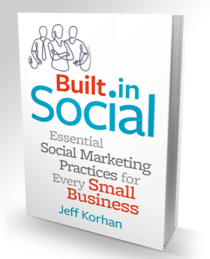
About the Author:  Jeff Korhan, MBA, is the author of Built-In Social: Essential Social Marketing Practices for Every Small Business – (Wiley 2013)  

He helps mainstream businesses adapt their traditional growth practices to a digital world. Connect with Jeff on LinkedInTwitterFacebook, and Google+.

12 Business Marketing Trends and Better Practices for 2013

2013

As a small business, you will have to respond to these business marketing trends to keep your business relevant in 2013.

As a business owner or manager, the suggested personal marketing practices will prove to be valuable for helping you to better implement them for maximum business marketing benefit.

Business Marketing Trends and Practices

#1 – Original Content is Highly Valued

If this wasn’t true, then media outlets would not always be racing to be the first to report the news to achieve the temporary prize of being first. There is no need to race when YOU are the only source.

Google Authorship is evidence that original marketing content – one of a kind – a category of one – will always be more highly prized.

#2 – Business is Now Personal

The personal perspective that you provide is what makes any type of content marketing original. Repurposing content is accepting mediocrity – something that places you in a race to the bottom.

#3 – Customers Want to Make Better Choices

Those who use their expertise to help their customers will earn their trust. First help your customers to be better buyers – then help them further with your expertise. So this year, help your community to simplify.

#4 – Social Media Will Not Fix Anything

If your business is broken social media will amplify that. So, to help you get better, why not consider blogging just for you. It will help you to dig deep and find better solutions for your customers.

#5 – Consistency Sets Expectations

How often should you be publishing to your online channels?  If you make regular contributions, even if that is quarterly, it is better than nothing at all – and certainly better than anything irregular. Consistency is a mark of professionals.

#6 – You Have to Love What You Do

I love to blog and it pains me that the gap since my last post is the widest in years. Looking on the bright side, I’ve just completed my first book on social marketing for small business and that is reward enough for me – especially if members of my tribe like you find it useful.

Personal Marketing Practices

#7 – Surprise Your Audience

Pay attention to those that nobody pays attention to – it could be the greatest gift they receive all year. Buy the person’s lunch in the line with you. Send an anonymous gift.

#8 – Show up Even When You are Unprepared

We all think that we need to be prepared, and we should be, but sometimes the most amazing days of our lives are those when we improvise from the heart in service to our communities. It’s a wonderful thing.

#9 – Face Your fears

Being yourself means facing your fears and doing what you know has to be done if you are to feel the sense of accomplishment that drives your happiness and success. When you do what is uncomfortable you learn things about yourself that help you to better serve your customers.

#10 – Love Yourself

Steve Jobs famously said, “they are no smarter than you are.”  When you really embrace that concept the fears that hold you back fall away. What’s left is the innate confidence in your own abilities that shines through.

#11 – Your Work is Never Done

If it were, then you would have nothing to aspire to. Try to view life, and certainly business, as a process – not a transaction. How can you do more together with your customers? They are probably wondering the same thing. Help them get what they really want.

#12 – Show Your gratitude

Believe it or not, being grateful for the contributions of others helps you just as much, if not more than them. When you put that positive energy into the world it helps you realize you are part of something bigger – an ecosystem that needs your contribution.

How about you?

What is your small business marketing manifesto for 2013?

If you liked this – please leave a comment below and share with your friends

About the Author:  Jeff Korhan, MBA, helps mainstream small businesses create exceptional customer experiences that accelerate business growth.  Get more from Jeff on LinkedInTwitter and Google+.

Jeff is also the author of Built-In Social:  Essential Social Marketing Practices for Every Small Business – Published by Wiley, April 15, 2013


Photo Credit