
The Power of Engagement in An Automated World

The Power of Engagement in An Automated World

Did you know that if you have consistently low engagement on Facebook the bar for achieving it the next time is raised even higher? That’s how the algorithims work.

While this may seem unfair, the truth is all of the networks favor people and businesses that already have a proven audience. To make room for them, much of everything and everyone else gets ignored.
In our media saturated world this makes complete sense. These channels are vying for people’s attention, so they want to deliver media that is most in demand.

Here’s basically how it works on Facebook. One, two, three strikes and you are out! If you publish three consecutive duds on your Facebook page, the algorithm reasons you are not ready for the big leagues and sends you to the minors.

You need to get some hits, and that means stepping back to assess what works well on the respective channels, while concurrently encouraging engagement with it.

To Earn More Engagement Start Engaging

The engagement metrics the respective social networks use to validate your authority include likes, comments, shares and retweets (or the equivalent). If your content is not earning these signals, especially shares, then you need a new plan.

Apply a similar analysis to other media channels, such as your blog and digital newsletters. If you are not receiving engagement, then either the content is missing the mark or you simply need to open the door to feedback.

I encourage and receive a responses to my newsletter every week. They are greatly appreciated because they help to make it better.

How about you?

The simplest way to enhance your engagement is developing a system for doing so. Here are a few ideas.

#1 – Ask influentials to share your content. You have to ask nicely and carefully choose before inquiring or you may close some doors forever. Of course, be sure the content is useful and relevant to their interests, and clearly communicate that.

#2 – Freshen your lists of subscribers and followers. Most of us have email lists of hundreds to thousands, but we only occasionally engage with a few. Consider personally emailing 5­-10 subscribers every week to connect and warm up your relationship with them. Apply similar tactics to Facebook, Twitter, LinkedIn and so on.

#3 – Seek sustainable impact. The surest way to sustain personal and professional relevance on all of your media channels is to test and analyze what earns engagement and publish more of it. Commit to making everything you publish a winner, because one­ hit wonders are soon forgotten.

That’s the goal. People like to engage with winners, and true winners graciously create opportunities for personal, one­-to-­one engagement.

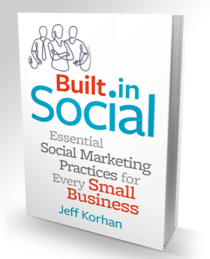
About the Author:  Jeff Korhan, MBA, is the author of Built-In Social: Essential Social Marketing Practices for Every Small Business and host of This Old New Business podcast.

He helps mainstream businesses adapt their traditional growth practices to a digital world. Connect with Jeff on LinkedInTwitterFacebook, and Google+

How Feelings and Experiences Move Buyers to Action

www.jeffkorhan.com buyers

Legendary sales trainer and motivational speaker Zig Ziglar often stated that selling is essentially a transference of feeling.

While logic is part of our decision making equation, people are more often moved to action for emotional reasons – and that includes responding to your social media marketing.

Understanding how to create contextual experiences that move people to action is what relationship selling is all about. This is why I like to say social marketing is the new relationship selling.

The reason in a nutshell is that the content that drives social marketing accomplishes what has traditionally been the responsibility of the sales team: engaging buyers with logic and emotion by building meaningful relationships with them.

What’s interesting is that unlike traditional selling, digital social marketing starts developing relationships with buyers even before the company is aware of them. Consider the significance of this.

It’s necessary to consider the customer experience your marketing will deliver – and the feelings your buyers will have in response to it.

What Do You Want Your Customers to Feel?

This is one reason why I interview people from my live audiences prior to building the presentation that I will deliver to them live. The better I can get to know them, the more easily I can visualize and feel a connection with them when I am onstage.

Understanding your customers is a never-ending practice for every business. Everything changes, so it’s up to business people like you and me to stay in touch with the most intimate feelings of our customers.

Once you clearly define both the logical and emotional needs of the customers you serve, you can be sure your marketing will speak directly to them. In particular, the more specific the language the better.

What Outcomes Do They Want to Experience?

The outcomes your customers desire will determine their most receptive emotional state. For example, if you are in the business of selling life insurance, it’s doubtful your audience wants to be revved up and excited.

More important for them is probably that your business is personally interested in them and respectful of their views on life, death, and family. The practical approach for most companies is instilling confidence that earns the buyer’s trust.

The truth is this:  Feelings and experiences move people to action, but trust is what gets them to sign on the dotted line.

Share Stories That Inspire Actions

It’s one thing to build traffic to your website and social media channels, but unless you are also sharing stories that will hold their attention and create memorable feelings, it’s unlikely that traffic will convert to profitable outcomes.

Now, before you start thinking you don’t have a lot of good stories, let me share my personal experience.

While writing my first book was a wonderful experience, the editing process was challenging. One of the reasons for this was that in addition to reconciling hundreds of technical corrections per chapter, the copy editor always came back to me for more stories for each and every chapter!

You know what? To my surprise, when put to the test I was able to deliver; and you will do the same if you make the commitment. The reason for this is writing is remembering.

You’ve already experienced thousands of stories worth sharing. All you have to do is commit to writing them down. You too will discover that once you get going it is not that difficult.

Just commit to getting them into your content and social media marketing to make the connections that will not only inspire your potential buyers – but also move them to action.

About the Author:  Jeff Korhan, MBA, is the author of Built-In Social: Essential Social Marketing Practices for Every Small Business – (Wiley 2013)  

He helps mainstream businesses adapt their traditional growth practices to a digital world.  Connect with  Jeff on LinkedInTwitter, Facebook, and Google+.

 Photo Credit

What’s Your Writing Process?

If you don’t have a writing process that you regularly practice, you will be challenged with consistently turning out quality content. Do you start with an outline? Do you rewrite? How many times will you edit? These and many other considerations, such as your writing environment, will greatly enhance your writing productivity. Whether you work […]

Read the full article

Every Business is Now a Media Company

There was a time when every business courted the media. They (the media) were rightfully considered business partners because they could significantly help any company interested in publicizing an event or similar happening as news. Today, every business (large or small) is now its own media company – and that is a responsibility that should not be […]

Read the full article

Google+ Hangouts Come Alive

There is a big difference between television and live television. Live television comes alive because there is anticipation and excitement about what is going to happen next. Photographer John Butterill applied this principle to Google+ Hangouts by taking it mobile, and indeed there is an equally significant, if not remarkable difference. The short video below […]

Read the full article

Stories Sell and Set You Free

One of my first experiences involving the successful use of story for practical business purposes was as an aspiring landscape contractor – the owner of a mainstream small business. My company was beginning to deliver really nice quality work, but we had yet to land that special project that we hoped would distinguish us in […]

Read the full article

10 LinkedIn Tips for Growing Your Business

This original article by Jeff Korhan (now updated) was published earlier at Social Media Examiner. Why should you use LinkedIn for networking? With 161 million business members, and a reputation as a trusted network, LinkedIn may be the most powerful business networking service both now and moving forward. How are you using LinkedIn to grow […]

Read the full article

Specific Solutions are Better

Has your company lost business to one whose solutions are inferior to yours? We have all experienced this frustration, and the truth is it is our own fault. The only reason anyone settles for a lesser solution is because they are not aware of what is better. When this happens, the problem is usually the […]

Read the full article

3 Hyperlocal Marketing Success Factors

While they may not be familiar with the term hyperlocal marketing, successful local businesses have learned it is essential to their continued prosperity. Hyperlocal suggests serving a narrowly defined niche – one that is largely defined by proximity. However, location is just one piece of the hyperlocal marketing puzzle. This weekend I worked with local […]

Read the full article

Imitators and Redefining Expertise

In the pre-digital era of publishing, the printed word carried a great deal of authority. The assumption by the general public was that “they” would never print anything if it wasn’t true. Of course, back then publishing was confined to established media outlets that employed professionals who were held accountable. Now anyone can publish, and […]

Read the full article