
5 Tips for Using LinkedIn Contacts

2013-05-15 LinkedIn Contacts

LinkedIn is in the process of rolling out LinkedIn Contacts. In addition to several new features that are giving it a new look and feel – if offers enhanced functionality for better managing your relationships and social engagement.

There is no question that all of the major social networks want you to use their service as your social dashboard. However, many social networkers prefer to use an independent tool such as Hootsuite to effectively manage their social networks and build relationships.

One of the challenges is there is a disconnect between public social networking and private means of communication that often lead to sales conversion – namely email. This is where services such as Nimble are leading the way, by bringing social and email into one dashboard, and one reason why I especially like LinkedIn Contacts.

What gets even more interesting is that concurrent with LinkedIn’s rollout of LinkedIn Contacts, Nimble has launched Nimble 3.0, and there are some interesting contrasts and similarities. (More on Nimble in a future article).

For now, here’s how to get the most out of LinkedIn Contacts.

#1 – Import Your Contacts

You have always been able to import your contacts from other sources into LinkedIn. However, now with LinkedIn Contacts there are multiple options for doing this – while also tracking where the source of those contacts. To get started, just go to contacts in your LinkedIn profile, and then settings.

2013-05-23 Linkedin Contacts


Some of the possible sources for importing contacts into LinkedIn

What is especially useful is the refresh button. So, let’s say you imported your friends from Facebook a month ago, just hit the refresh button to bring in the new ones.

Incidentally, while Facebook does not let you export the email addresses of your friends, there is a workaround using Yahoo Contacts to import your Facebook contacts into LinkedIn. Since Facebook is not prone to sharing, I suggest doing this now to avoid the risk that this capability will be blocked in the future.

Know that you won’t get all of them, because not everyone has an email address publicly linked to their Facebook profile.

#2 – Set Reminders to Connect

It’s easy to make that first connection, but anybody that has ever attended a live networking event knows that often nothing happens after that. In the old days, business cards got pushed into a drawer. Today, connections are made and forgotten days later.

So, a great solution is to use LinkedIn Contacts to set a reminder to follow-up with your connections a few weeks or so later. At the very least, your new connection will be impressed with your organization, and if you can also share some useful information, better yet.

 LinkedIn reminders, tags, notes, and conversation history


LinkedIn reminders, tags, notes, and conversation history

#3 – Merge Duplicate Contacts

Many people unknowingly or not set up multiple profiles on LinkedIn. As a result, you may find yourself connecting with their abandoned profile because they did not delete it.

Now LinkedIn pulls up what they believe to be all duplicate profiles so that you can merge them. You simply unclick those on the list where the same name is actually two different people. Then just click merge and just like that – you have cleaned up your database

#4 – Tag Your Connections

It appears that LinkedIn automatically assigns a tag such as colleague or friend based upon the respective social graphs or source of the contacts. Regardless, you should be making the effort to accurately tag your connections

This is the true power of a CRM – using tags to create micro-communities. If you do not have a means for targeting your message for a specific community, then you run the risk of having it reduced to spam.

When that happens, your ability to connect with future opportunties is compromised, because you have lost the trust that you may have otherwise earned.

#5 – Note Relevant Information

I have always wondered about the privacy of the notes feature in LinkedIn, and have now confirmed that profile notes are private to you.

So, when you make a connection, jot down important notes for later use – including how your met and any opportunities that may have been discussed. It’s easy to forget, so take the time now, so that when that follow-up reminder pings you later you’ll recall important information.

LinkedIn co-founder Reid Hoffman likes to say, “It’s better to be the best connected than the most connected.”

Now LinkedIn is not only giving you the tools to do so, but making them seamless and easy to use for getting more from this platform.

In addition to that, LinkedIn plays well with others. So, while Google and Facebook continue to slug it out on their respective properties, it’s nice to know you can count on LinkedIn as a friendly and neutral partner.

If you are still looking for more from LinkedIn, consider setting up your LinkedIn Business Page.

How about you? How are you using LinkedIn to grow your business? 

About the Author:  Jeff Korhan, MBA, helps mainstream small businesses create exceptional customer experiences that accelerate business growth. Get more from Jeff on LinkedInTwitter and Google+.

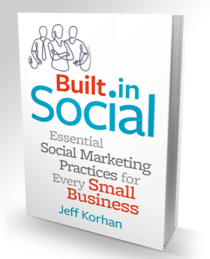
Jeff is also the author of Built-In Social: Essential Social Marketing Practices for Every Small Business – Just Released April 2013 (Wiley)

Social Marketing is Relationship Selling

 The Social Marketing Process ©Jeff Korhan


The Social Marketing Process ©Jeff Korhan

Mainstream small business will more reliably get better results from social media if they view it more as selling than marketing. Why?

Because effective relationship selling is personal, and now marketing is too. As social influences continue to profoundly affect business, just about every business activity is going to require relationship building skills.

Traditional marketing or advertising was something you did – to your communities. Whereas, social marketing in our digital environment is something we do – with our communities. That feels a lot like selling to me.

So, an important question is what aspects of your selling process reliably bring in new business? Then consider how you can make that more personal, and as a result, more relevant to today’s buyer.

Adapt to Today’s Buyer

The common expression, “What got you here won’t get you there” – is mostly untrue.

The truth is: It will. All you have to do is know your strengths and learn to ensure their relevancy for the inevitable changes in the business environment.

When I was launching my residential landscape business in the late 80′s I used a practice to educate my communities. That practice – known today as content marketing - was my primary means for generating leads (with referrals from happy customers being the other source of new business).

My only challenge in adapting what worked well was translating from a print to this digital platform where my future customers are likely to be found.

So, how did your business build relationships with new buyers? Give that some thought, because your growth practices are still valid, especially if you figure out how to adapt them to the new habits of your buyers.

For example, if your business growth is the result of efficient production methods that speak for themselves, then that is a vital selling factor that you should continue to use. Now you can easily amplify that using videos to reach buyers where they are – which today is usually online.

A Valid Process is Your Guidance System

Your sales process is more than a series of steps. It is a guidance system that makes everyone aware of what should be happening, and how to get it back on track if it isn’t.

Whether they acknowledge it or not, most people admire what is reliable. This is why having having a valid process that keeps your you and your sales team focused on the right variables is something that gives your buyers confidence in working with your company.

Learn to use your sales process to differentiate your business. The majority of companies are busy selling their products and services. As a result, it all sounds the same to the buyer, because they are all  focused on what they doproducts and services.

Whereas, the business that focuses on how they do it better is the one that will earn the attention of today’s buyer. And that is accomplished by first selling your process – then your products.

Isn’t this what Zappos does? They are selling the same shoes as every other merchant, but the process for acquiring those shoes is what made their business the market leader.

It’s all about considering how buyers would buy if they could – and then giving them that process.

The bottom line is a valid process builds trust, and that makes it essential for your social marketing AND relationship selling.

Want to learn more about refining your sales process and using it to differentiate your business? It’s covered in detail in Built-In Social: Essential Social Marketing Practices for Every Small Business.

When you learn to build a process for your social marketing that is based on basic relationship selling practices, you will never look back – because you will be forever focused on the two things that matter most:

  1. Your business strengths
  2. How your customers ideally want to buy

What are your thoughts? Please share them in a comment.

About the Author:  Jeff Korhan, MBA, helps mainstream small businesses create exceptional customer experiences that accelerate business growth. Get more from Jeff on LinkedInTwitter and Google+.

Jeff is also the author of Built-In Social: Essential Social Marketing Practices for Every Small Business – Just Released April 2013 (Wiley)

If I Were Starting Social Media from Zero

A couple of months ago without notice, all of the social media sharing counters on my primary website had reverted to zero. Just like that, thousands of shares that had accumulated over a period of nearly seven years had vanished. Why is this significant? Social sharing is what is known as “social proof.”  It’s evidence [...]

Read the full article

Social Media is Still Uncharted Waters

When you are embarking on a journey whose destination is uncertain, you have to get comfortable with uncertainty. When it comes to social media, uncertainty has been, and for the foreseeable future, will necessarily be part of its use in your marketing equation. These are uncharted waters. Everyone is still learning. So, small businesses simply [...]

Read the full article

Why The Best Products are Souvenirs

Marketing expert Seth Godin has more than once noted that a book is souvenir – a vessel for ideas that allows them to be readily used and shared. I believe we can further expand on that idea. Have you ever considered that the products and services your small business creates are souvenirs too? What Exactly [...]

Read the full article

Small Business Social Media Accountability

Recent tragic events here in the United States (and around the world) have heightened awareness of the global reach of media, especially social media, and the consequences for businesses using it. Small business advertising has historically been local, making it easy to craft messaging that is appropriate for the targeted audience. However, now any piece [...]

Read the full article

Social Media for Small Business – It’s Still Early Days

The art of marketing has always been about making meaningful connections with ideal buyers. Modern marketing is a practice that is new to most small businesses. Prior to that small businesses made meaningful connections through selling, not marketing. One of the reasons for this is that most of the media available in recent decades, including magazines, [...]

Read the full article

Why Writers Should Practice Meditation – And How to Get Started

Meditation is usually associated with relaxation and stress release, but those outcomes are more accurately by-products of the practice. The true purpose of meditation is to quiet the mind. When that happens, all kinds of personal benefits ensue, including improved health and resiliancy, greater awareness, and the spiritual awakening that comes from tapping into one’s [...]

Read the full article

Local Business Networks Intersect

Local businesses are their own location-specific network, and they tend to support each other and freely share without compromise. Now consider that there are countless local networks – and they all intersect. What is your business doing to tap into at least one of them? Local Businesses are More than Local When you buy local [...]

Read the full article

Advertising That Enhances the Media Experience Works

Advertising (especially digital) has earned a reputation as something interruptive, and therefore, unwanted. Selling earned the same reputation back in the days of the stereotypical fast talking salesmen. In both circumstances, the problem was not with the medium for communicating the message – it was the message itself. While social media has in many ways [...]

Read the full article