
3 Facebook Hashtag Marketing Tips

2013.6.13 hashtags

The newly launched Facebook hashtags could prove to be the savior of Graph Search – the recently launched Facebook search feature.

Graph Search does what it promises – returning search results based on the social graphs of your Facebook friends, fans, and followers. This means that you tend to see search results only for those friends and businesses with whom you are already closely aligned.

If you happen to be using Facebook for outreach and marketing, the new hashtag feature will extend your reach dramatically. This will create both risks and rewards, so you will want to choose your hashtags with care.

 #1 – Avoid Desperation Marketing

What I am already noticing are Facebook posts that include a rash of hashtags. As expected, the inevitable hashtag spam has just begun. We have not seen this with Twitter hashtags because the 140 character limitation keeps it in check.

 One example of Facebook hashtag spam


One example of Facebook hashtag spam

This is just one more example of desperation marketing. We are already familiar with this in its many forms. These include:

  • Sensationalized headlines
  • All caps and excessive use of exclamation points
  • Controversy and false claims

Now add a truckload of hashtags to that and you have a real mess that is sure to annoy those that you presumably most want to engage and inspire to action.

Smart businesses know that desperation marketing only serves to repel potential buyers.

When you use dozens of hashtags you tell the Facebook search engine that your post has no focus. So, all you are really doing is spamming your friends and fans.

Don’t do it.

#2 – Hashtags Are Keyword Tags – Use Them Well

Given that the effectiveness of Facebook search is marginal at best, hashtags can be quite useful for tracking your content. However, this isn’t going to work if you are using broad keyword phrases – such as #smallbusiness.

A broad keyword tag or hashtag is the same as none at all. As we all know, saying “one size fits all” means it doesn’t fit anyone well.

Use a hashtag that is personal to you, such as your business name. One that I’ve been using lately is #builtinsocial, which happens to be the title of my new book.

When I search for the hashtag #builtinsocial I’m confident the results I receive will for the most part be mine and mine only. That should be your objective.

Think of your hashtag as a link to you, your business, or one of its products or services. To accomplish that, you have to be specific.

Also consider that using broad category hashtags aggregates your content with everyone else that uses it (to the extent that your privacy settings allow), a practice that will likely align you with hashtag spammers.

Is that what you want?

#3 The Best Marketing is Specific

Mass marketing may work well for big consumer brands, but not for your small and probably local business.

If you really want to use hashtags well, use them to create alignment with a highly targeted group. This is why location hashtags will prove to be especially popular for local small businesses.

Think of your hashtags as the language of your desired community. If there are specific words or phrases that speak to your community, those words as hashtags will serve as markers that will rise to the surface in Facebook conversations.

You can also coin your own hashtag keywords and use them to brand your business.

The introduction of hashtags on Facebook, a site that is frequented by many that are not necessarily social media savvy, is sure to bring their use into the mainstream.

So, get ready for what may prove to be a game-changer for Facebook marketing.

Apply these 3 hashtag tips to your Facebook marketing and you are sure to notice favorable results.

Update: The discussion on this has been raging on Facebook. Thus far, we’ve confirmed that hashtags work on posts, with photos, and with some – but not all comments.  We will not know all the facts until this completely rolls out. Also, your privacy settings prevail, with hashtags aggregating content within that sphere of influence to other content using the same tag.

Leave a comment below if you have questions or ideas to share.

About the Author:  Jeff Korhan, MBA, helps mainstream small businesses create exceptional customer experiences that accelerate business growth. Get more from Jeff on LinkedInTwitter and Google+.

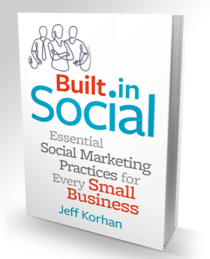
Jeff is also the author of Built-In Social: Essential Social Marketing Practices for Every Small Business – Just Released April 2013 (Wiley)

Photo Credit

Connected Economy Alignment is Value

Social

In this connected economy, the challenge is not connectivity – but alignment.

If you look for differences you will find them; and if you seek alignment, cooperation, and collaboration, you will find that too. This is why learning to effectively manage your business networks is without question the key to your business success.

Alignment is the result of taking connectivity to the next level. This is often accomplished by partnering or collaborating to progressively achieve mutually beneficial objectives.

Who are these partners?

These are logically team members, friends, and influencers, but could also be what you to be competitors.

Alignment Builds Value

When a company gives freely, it earns the respect of the community, and that creates alignment. When a business is creating and sharing solutions that are relevant to their communities, alignment is naturally achieved.

This is why businesses need to start thinking of being problem solvers, what I like to think of as being in the answers business.

In addition to the content solutions that your business shares online, your products and services are also tangible and desirable solutions.

However, it is vital to first share free content in the form of tips and advice. That is what attracts buyers to what your business is selling. It’s a process of attraction that leads to engagement to build relationships and trust that ultimately lead to profitable outcomes.

The Social Marketing Process ©Jeff Korhan


The Social Marketing Process ©Jeff Korhan


Business in The Trust Economy

Like it or not, our business environment is being profoundly shaped by the influences of social media, and smart businesses are learning they can prosper if they seek to understand and embrace it.

Many of us are competitive by nature. Yet, when we channel those energies toward increasing value for the communities we serve, we can not only achieve our goals, but help others do the same.

Being a team player is a skill that ranks above technical talents. This is why nearly anyone will choose to to align their business with partners they trust, and therefore enjoy working with.

Communities are the New Markets

Traditional marketing speaks to markets, which are an abstract construct created by businesses that want to sell to buyers.

That’s a model that has become irrelevant in this connected and socially influenced economy. Consumer now have a voice, and every business should be finding new ways to engage customers with your brand.

We all live and work in local communities. So, respecting their dynamics is essential for succeeding in a trust economy.

It has taken me some time to learn this, but the feedback I am consistently receiving these days underscores its value.

This recent quote from Twitter is an example:

2013-06-07 Collaboration

Truth be told, that tweet was the inspiration for this post.

So, look no further than the comments of your community friends and followers for what matters most.

Pretty simple, huh?

About the Author:  Jeff Korhan, MBA, helps mainstream small businesses create exceptional customer experiences that accelerate business growth. Get more from Jeff on LinkedInTwitter and Google+.

Jeff is also the author of Built-In Social: Essential Social Marketing Practices for Every Small Business – Just Released April 2013 (Wiley)

Every Business is Now a Media Company

There was a time when every business courted the media. They (the media) were rightfully considered business partners because they could significantly help any company interested in publicizing an event or similar happening as news. Today, every business (large or small) is now its own media company - and that is a responsibility that should not be [...]

Read the full article

5 Tips for Using LinkedIn Contacts

LinkedIn is in the process of rolling out LinkedIn Contacts. In addition to several new features that are giving it a new look and feel – if offers enhanced functionality for better managing your relationships and social engagement. There is no question that all of the major social networks want you to use their service as your social [...]

Read the full article

Social Marketing is Relationship Selling

Mainstream small business will more reliably get better results from social media if they view it more as selling than marketing. Why? Because effective relationship selling is personal, and now marketing is too. As social influences continue to profoundly affect business, just about every business activity is going to require relationship building skills. Traditional marketing or advertising was [...]

Read the full article

If I Were Starting Social Media from Zero

A couple of months ago without notice, all of the social media sharing counters on my primary website had reverted to zero. Just like that, thousands of shares that had accumulated over a period of nearly seven years had vanished. Why is this significant? Social sharing is what is known as “social proof.”  It’s evidence [...]

Read the full article

Social Media is Still Uncharted Waters

When you are embarking on a journey whose destination is uncertain, you have to get comfortable with uncertainty. When it comes to social media, uncertainty has been, and for the foreseeable future, will necessarily be part of its use in your marketing equation. These are uncharted waters. Everyone is still learning. So, small businesses simply [...]

Read the full article

Why The Best Products are Souvenirs

Marketing expert Seth Godin has more than once noted that a book is souvenir – a vessel for ideas that allows them to be readily used and shared. I believe we can further expand on that idea. Have you ever considered that the products and services your small business creates are souvenirs too? What Exactly [...]

Read the full article

Small Business Social Media Accountability

Recent tragic events here in the United States (and around the world) have heightened awareness of the global reach of media, especially social media, and the consequences for businesses using it. Small business advertising has historically been local, making it easy to craft messaging that is appropriate for the targeted audience. However, now any piece [...]

Read the full article

Social Media for Small Business – It’s Still Early Days

The art of marketing has always been about making meaningful connections with ideal buyers. Modern marketing is a practice that is new to most small businesses. Prior to that small businesses made meaningful connections through selling, not marketing. One of the reasons for this is that most of the media available in recent decades, including magazines, [...]

Read the full article