

One of the important social media trends for 2014 is making financial investments in the major social media networks in order to accomplish specific objectives, otherwise known as pay to play.
The key is to distinguish between an investment and expenditures that deliver little future value.
LinkedIn, Facebook, and Twitter are now public companies. They are expected to grow the investment that shareholders have made in their shares, with that money naturally coming from users of the site that heretofore have enjoyed a free ride.
It has been apparent for some time now that your reach on Facebook is limited without advertising. It is evident that while Facebook advertising may indeed reach new fans, that does not necessarily convert into practical outcomes.
If you have not yet experimented with advertising on these social media channels, now is the time to do so before the pricing gets out of reach for most small businesses. However, be aware of end game – what you ultimately want to accomplish with that investment, otherwise it doesn’t make sense to play.
#1 – Quickly Building New Communities
If you are just getting started with new social media channels, it may make sense to make an investment up front to achieve critical mass more quickly.
For example, if the business is moving into a new market, it will be helpful to attract fans that are currently aligned with established competitors. Here is an excellent article that suggests ways for advertising on the major social media networks to build traffic to your account.
In reality, you are paying to rent the attention of a specific community. Your advertising dollars are buying a look from people that are known to have an affinity for businesses or brands like yours. If your content is solid you will most likely retain a generous number of them.
Of course, other ways to accomplish this for free are to partner with others in your space who will freely help you in exchange for a non-monetary value exchange.
#2 – Growing Your Content Marketing Assets
Let’s be clear that we are all renting space on Facebook, LinkedIn, and Twitter. For most that is free rent.
So, when does it make sense to pay to rent when everyone most others are not? When there is a direct conversion from that Facebook account into new business, or when it drives traffic to another site that converts it, such as your primary website.
Too many businesses are chasing Facebook likes that merely serve as social proof. There is nothing at all wrong with this. Facebook is great for nurturing relationships. However, one should question whether it’s necessary to invest in that or allow to happen organically.
If any of the social networks can help to build properties you own that can convert that traffic into profitable outcomes, such as your blog or email newsletter, then the investment makes sense.
In other words, pay to play when it builds traffic that can be converted.
#3 – Promoting Offers Designed to Convert
If your business has a specific offer with a limited window of opportunity, then investing to ensure it reaches as many targeted potential buyers as possible makes sense.
This may be the most logical reason for investing in social media advertising because social marketing is generally used to educate, not promote. It’s a process that is designed to convert attention into revenue when the time is right. This will include engaging not only the attention of that audience, but everyone that their social graphs.
Just as there is a difference between gambling and playing cards to win in the Las Vegas casinos, so it is with advertising. Gamblers like to say they enjoying playing cards, even when they are losing money, and you will always see them looking at a list of all the free bet deals for the grand national so they could get in.
Personally, I enjoy winning.
As pay to play becomes more common, it will be necessary to establish a budget with specific objectives, presumably to earn a profit from that investment. Intermediate objectives can be building your tribe, but ultimately offers have to be made that will generate a profit.
It doesn’t make much sense to invest in getting your content shared unless you have designed specific methods for earning back the investment, plus a reasonable (or better) profit.
Make sense?
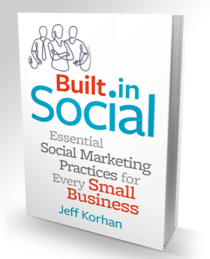
About the Author: Jeff Korhan, MBA, is the author of Built-In Social: Essential Social Marketing Practices for Every Small Business – (Wiley 2013)
He helps mainstream businesses adapt their traditional growth practices to a digital world. Connect with Jeff on LinkedIn, Twitter, Facebook, and Google+.

Responding to Positive Web Comments
Why does the concern for managing negative web comments overshadow the practice of skillfully responding to positive comments?
Positive comments are the seeds of conversations and the beginnings of new relationships. Shouldn’t this be the focus of your social networking?
The focus on having a strong defense (as opposed to a strong offense) suggests that many businesses are using their social media to market in a traditional fashion. In other words, they want to control the message, instead of giving up control to their customers to get them talking favorably about their brand.
If your response to favorable comments on your social media channels is “Thanks,” then it’s time to learn how to better use this interactive platform to more effectively accomplish your objectives.
You’ve Received a Comment: What’s Next?
The first thing that should come to mind when receiving any comment is what to do next.
One thing is clear, any response to a comment is always better than none at all.
Fortunately, networks such as Twitter, Facebook, and Google+ allow you to favorite, retweet, like, +1, and share. These social signals are a quick and easy way to acknowledge comments with the bare minimum effort. This should be standard practice.
When you respond to social media comments you honor the commenter. In most situations, that is enough to give a boost to their day, especially if you happen to be influential or someone they look up to.
You would think that influential people with large followings are mostly unresponsive to comments. My experience and that of others is quite the opposite. While they may be using a team to manage their social media, they understand the need to be actively engaged with their followers.
Of course, there are people with large followings that seldom if ever respond, and if they do, it is usually only to influentials and their very best friends. This is a bad practice, sort of like giving preferential treatment to your largest customers and ignoring the others.
Remember that social media democratizes media, so it’s always best to be inclusive.
If you are a business, you should endeavor to respond to every single tweet, share, and comment, regardless of the social channel.
Responding to Positive Comments
1. Acknowledge Intent
The primary value of a positive comment is its intent, not necessarily the usefulness of what may have been shared. Thus, when you acknowledge that you honor the person making it.
2. Make a Connection
Do you have something in common with the commenter? If so, blend that into your comment. Now you are referencing a shared relationship to thereby establish common ground.
3. Share an Idea
We talk a lot on the social networks about sharing value, but that isn’t always appropriate with brand new connections. It could be interpreted as “selling.” A better practice is to introduce a new possibility.
4. Suggest a Next Action
This can be a little tricky. Once again, avoid the inclination to promote. Simply encourage the commenter take action on what they specifically acknowledged in their comment, which often is the message of your blog post or article.
5. Keep the Conversation Going
If you are building your systems, you will have a method in place for circling back to take the conversation further. This could be running through your starred tweets or recent comments on your Facebook business page. However you accomplish this, it should be part of an integrated plan.
Your Social Media Implementation Plan
If you are a subscriber to my weekly newsletter, you have already seen this recent issue for building Your Social Media Implementation Plan. If not, you can subscribe right here to get future (and free) updates.
Responding to comments, both favorable and unfavorable, should be a micro-process within your overall social media marketing plan. My experience is that most businesses do not have a social media implementation plan, or if they do it is not written down.
Your social media will not come alive until you discipline yourself to build a plan, have it written down in a step-by-step manner, and then endeavor to update it periodically. As you know, technology changes, and that will affect the focus that your business should be taking.
You will most skillfully respond to positive web comments by taking a few simple actions. If they are part of a larger plan, you will have the confidence that your entire team is working in sync.
And that’s a positive thing!
Share your thoughts with a positive comment.
Photo Credit